Open post
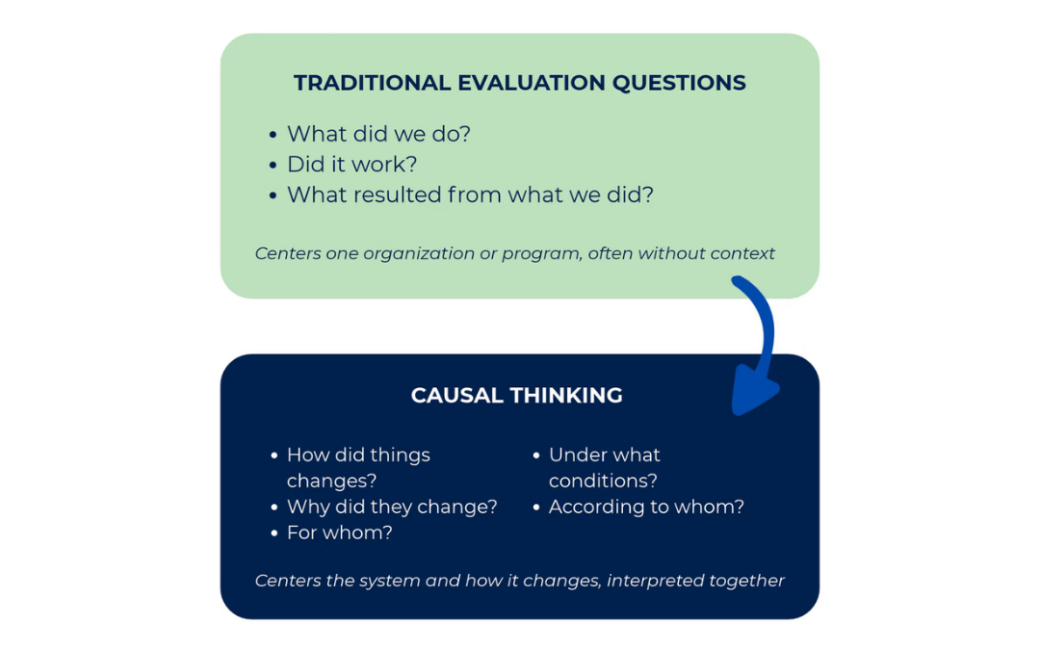
Graphic comparing traditional evaluation questions with causal thinking questions about how, why, for whom, and under what conditions change happens.

Planting the Seeds of Causal Thinking

A New Reflection on Understanding How Systems Change

How can foundations, organizations, and communities better understand how change is happening—not simply whether a program or strategy “worked”?

In a new blog post for the Causal Pathways Initiative, The L.E.A.D. Agency’s Founder and Chief Possibility Catalyst, Dr. Kimberlin Butler, joins Alison Gold to explore how causal thinking can become part of everyday strategy, learning, and decision-making.

The post introduces five questions:

  • How did things change?
  • Why did they change?
  • For whom did change occur?
  • Under what conditions did change happen?
  • According to whom?

These questions reflect The L.E.A.D. Agency’s commitment to participatory and emergent learning. Understanding change requires more than one organizational or institutional perspective. It also requires listening to people whose lives are directly shaped by systems and recognizing their lived expertise as essential knowledge.

Causal thinking does not have to begin with a formal evaluation. It can begin with a better question, a newly visible assumption, or an honest conversation about what is changing and what that learning asks us to do differently.

Read the full blog post on the Causal Pathways website.

Open post
Community Experts Team members and partners participating in a facilitated group discussion during the Tower Foundation’s participatory grantmaking process.

Power Shared, Possibility Realized: Youth-Possible Philanthropy® in Practice at the Peter & Elizabeth Tower Foundation

Originally published as a Perspectives piece by Grantmakers for Effective Organizations (GEO).

What does shared power look like when young people are trusted not only to advise philanthropy, but to make decisions?

This Perspectives piece explores the Peter & Elizabeth Tower Foundation’s Community Experts Team (CET), a participatory grantmaking model in which young people with lived experience help design the grantmaking process and make funding decisions. It illustrates Youth-Possible Philanthropy® in practice—bringing together youth participatory grantmaking, trust-based philanthropy, an equity-centered approach, multi-sector collaboration, participatory learning, and possibility development.

The piece also highlights The L.E.A.D. Agency’s role as a learning partner to the Foundation and the CET Possibility Lab, where young people engaged directly with evaluation findings, interpreted what the learning meant, and helped identify possibilities for the program’s future.

At its core, the story asks philanthropy to move beyond inviting youth into existing structures and toward creating the conditions for young people to share power, shape meaning, and lead.

Read the full Perspectives piece at Grantmakers for Effective Organizations.

Open post
Branded featured image for “Engaging Youth in Philanthropic Practice,” showing The L.E.A.D. Agency and The Foundation Review branding and highlighting Youth-Possible Philanthropy®.

Engaging Youth in Philanthropic Practice: Field-Building Strategies and the Promise of Youth-Possible Philanthropy®

Originally published in The Foundation Review, Volume 17, Issue 1 (2025).

How might philanthropy change if young people were positioned not simply as participants, but as co-creators and possibility catalysts?

In this peer-reviewed article, Dr. Kimberlin D. Butler introduces Youth-Possible Philanthropy®, a field-building framework for strengthening meaningful youth participation, shared decision-making, and power-sharing in philanthropic practice. The article examines persistent gaps in how philanthropy engages young people and explores how possibility development, participatory approaches, and trust-based philanthropy can help create more authentic roles for youth in philanthropic governance and strategy.

The article also offers strategies and examples for moving from intention to practice—creating conditions in which young people can help shape decisions about the issues, communities, and futures that affect them.

Read the full article in The Foundation Review.

Suggested citation:
Butler, K. D. (2025). Engaging Youth in Philanthropic Practice: Field-Building Strategies and the Promise of Youth-Possible Philanthropy™. The Foundation Review, 17(1). https://doi.org/10.9707/1944-5660.1725

Scroll to top